
Following A New “Greenprint”

Following A New “Greenprint”

When city leaders in Louisville, Ky., signed the Greenprint Charter, they weren’t launching another beautification project. They were testing whether science and collaboration could reshape the future of an urban core.

5 min read

How Louisville is using science to shape a healthier downtown


When city leaders in Louisville, Ky., signed the Greenprint Charter, they weren’t launching another beautification project. They were testing whether science and collaboration could reshape the future of an urban core. The initiative brings together government, researchers, and community partners to examine how targeted greening can improve public health and support downtown recovery.

A Framework For Coordinated Greening

The Greenprint initiative grew out of a shared recognition that downtown Louisville needed more than traditional development to recover from economic and social shifts. The city’s post-pandemic landscape included underused spaces and reduced foot traffic. City leaders, funders, and researchers began discussing how urban greening could help restore vitality while addressing issues such as air quality and public health.

The result was the Greenprint Charter, an agreement that outlines principles for cooperation among organizations representing local government, higher education, nonprofits, foundations, and private partners. The framework encourages partners to align their projects, share data, and track outcomes to determine what types of greening provide the greatest benefit.

The University of Louisville’s Christina Lee Brown Envirome Institute provides the scientific foundation for the initiative. The Institute will use environmental monitoring and data analysis to measure the effects of tree planting, pollinator habitats, and other green infrastructure on air quality, heat reduction, and biodiversity.

“The Greenprint Project is an exciting collaboration with several partners committed to making Louisville a healthier, greener city. This initiative offers a unique opportunity to reimagine and revitalize downtown Louisville,” says Dr. Aruni Bhatnagar, Director of the institute. “Using an evidence-based approach, the project will create a ‘greenprint’ designed to enhance both environmental quality and public health. The model we develop could serve as a scientific framework for greening downtowns around the world.”

The James Graham Brown Foundation provided $1.5 million in seed funding to launch the effort.

“The Greenprint initiative reflects the kind of bold, collaborative vision the James Graham Brown Foundation is proud to support,” says Mason Rummel, the foundation’s President and CEO. “By aligning science and community input, this effort has the potential to transform downtown Louisville into a national model for place-based investment in public health and urban vitality.”


Collaboration And Early Implementation

The partnership includes a range of organizations with different responsibilities and expertise, including Louisville Metro Government, Metro Parks, the Parks Alliance of Louisville, Waterfront Park, Trees Louisville, and the Olmsted Conservancy, among others. Each brings a distinct role in design, implementation, and community outreach.

“Downtown is the heart of Louisville and revitalizing our downtown benefits every Louisvillian. The Greenprint initiative shows what’s possible when government, nonprofits, businesses, and community partners come together around a shared vision,” says Louisville Mayor Craig Greenberg. “By using nature as a tool to strengthen our neighborhoods and create welcoming spaces, we are making downtown safer, healthier, and stronger for everyone—and setting an example that other cities across the country can follow.”

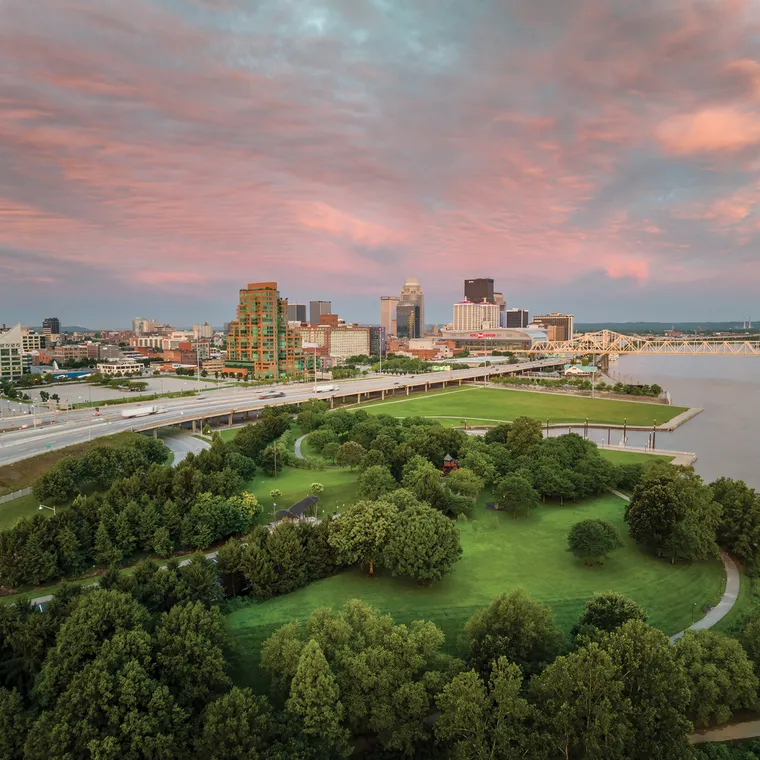
Photo: Courtesy Of Waterfront Park

In the first phase, the partnership has identified sites for small-scale greening interventions, such as microforests and pollinator gardens. These early projects serve as test cases for design and data collection. Results will inform future decisions about larger-scale improvements across the downtown area.

Managing the partnership required significant planning and communication among charter-signers. Participants agreed on shared definitions for greening projects and reporting methods. Funding beyond the foundation’s initial contribution will come from a variety of sources, including grants, public dollars, and private partners. The intent is to integrate projects into existing operating budgets rather than rely solely on external awards.


From Pilot Project To Model

One of Greenprint’s distinguishing features is its reliance on data. The institute will collect baseline environmental measurements before projects begin and continue tracking conditions afterward. These include air temperature, particulate matter, and soil quality, as well as indicators of public health such as heat-related illness rates. Results can be shared with the public and can be designed to make the information accessible to residents and policymakers.

Greenprint also emphasizes transparency and community involvement. Organizers hope that making data visible will help residents understand the connection between environmental design and quality of life.

The approach may hold lessons for other cities. By formalizing collaboration through a charter, Greenprint creates accountability among partners without centralizing control under a single agency. The model depends on shared governance rather than hierarchy. Leadership shifts among partners based on project type, location, and expertise.

Louisville Metro officials describe this flexibility as a key strength. It allows different departments and organizations to lead when appropriate while maintaining alignment through consistent measurement and reporting. That structure has helped keep momentum as the project moves from planning into implementation.

As projects advance, the team expects to release findings on environmental indicators and cost efficiency. The next phase will focus on connecting individual sites into larger green corridors linking downtown with surrounding neighborhoods. Partners are also in discussions with local healthcare institutions to explore how greening can reduce the urban heat effect and improve health metrics in vulnerable areas.

Greenprint’s organizers emphasize that the model is still evolving. The framework is designed to accommodate new partners and projects as opportunities arise. The hope is that the charter provides both structure and flexibility, a way to sustain progress even as political and funding environments change.


Looking Ahead

For parks and recreation professionals, Greenprint offers insight into how coordinated planning and measurable outcomes can strengthen urban greening efforts. The Louisville model demonstrates that aligning partners early and integrating data collection from the start, before installation, can prevent many common challenges.

It also highlights the role of philanthropy in facilitating cross-sector collaboration. By funding early coordination and data systems, the James Graham Brown Foundation helped establish a structure that public agencies can now build upon.

Louisville’s experience suggests that revitalizing public spaces through environmental design requires both science and storytelling. Data can measure impact, but community support sustains it. As the city continues its work, the Greenprint Charter can serve as both a test and a template for how nature can become an active part of downtown recovery.