How Miami’s The Underline built an economy of connection
By Eulois Cleckley
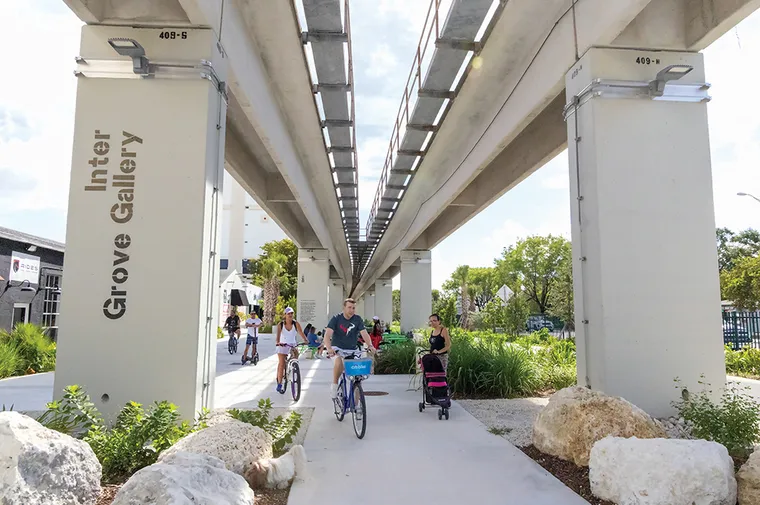
Miami has always been a city that moves fast and dreams big. From its art deco past to its tech-forward present, this community thrives on reimagining what’s possible. That same energy fuels The Underline, a 10-mile, multimodal, urban park beneath Miami’s Metrorail that serves as a corridor of connection, commerce, and culture.
The Underline is a people-driven project that began with a simple question from founder Meg Daly: What if the land beneath the Metrorail could be repurposed to bring the community together? That question became a catalyst. Today, the project is transforming 120 acres from Brickell to Dadeland into a series of parks, trails, plazas, and gathering spaces. With full completion approaching next year, The Underline has already proven that public spaces can go beyond beautifying a city, strengthening its economy and its people.
The Underline’s success lies in how it supports movement in every sense of the word. It helps people get where they need to go, but it also helps businesses grow, connects communities, and creates pathways to opportunity. Through design, programming, and partnership, the team at Friends of the Underline has learned what it takes to turn a public park into a local economic engine.
1. Build Spaces That Foster Commerce And Community
Great design creates opportunity. In Brickell, The Underline Market has become a community staple. Dozens of vendors fill the space each week with crafts, produce, and local cuisine, while musicians and performers turn the plaza into a neighborhood celebration. The market draws thousands of visitors each month and supports hundreds of small businesses annually. Many of these vendors are homegrown entrepreneurs who found their first customers there.
The new Inter Grove Gallery in Coconut Grove expands on that concept. This 150,000-square-foot site is being developed as a flexible hub with container retail, food trucks, pop-up kitchens, and a rotating art program. It gives entrepreneurs an affordable and visible place to launch and scale. These spaces were designed for activity: open, adaptable, and deeply connected to the neighborhoods they serve.
"Miami thrives on projects that blend innovation and community. Our partnership with The Underline and the Inter Grove Gallery represents that vision, where a coffee at the Inter Café or a ride from our bikeshare program becomes part of a larger movement to build a more connected city,” says Kaio Philipe, Chief Business & Marketing Officer at Inter. "We see this space as a catalyst for engagement and opportunity, which is what investing in community truly looks like.”

2. Connect A Community Beyond The Limits Of A Park
A successful park doesn’t exist in isolation. From the start, the project team asked how The Underline could reach communities not directly on the corridor. That led to Community Connections, a program that brings The Underline’s reach to neighborhoods across Miami-Dade.
At a recent event in Miami Gardens, Easy Cookin’ with Sy, a catering and private-chef business founded by Food Network winner and licensed therapist Chef Syerra Lynn, joined in a day of food, music, and community that drew hundreds of residents, new and existing patrons alike. From her Spice Magic seasoning line to her cooking classes, Chef Sy represents the type of creativity and entrepreneurship that Friends of the Underline is proud to help showcase citywide.
Reflecting on the experience, Chef Sy shared that “being part of Community Connections was such a powerful reminder of how food brings people together. The Underline’s commitment to connecting spaces and souls aligns perfectly with my mission to heal through the plate by merging culture, creativity, and community.”
3. Cultivate Public-Private Partnerships That Create Pathways
No park achieves this level of transformation on its own. The Underline exists because of the collaboration among Miami-Dade County, the City of Miami, Coral Gables, South Miami, private donors, nonprofit partners, and corporate supporters. These partnerships have turned the park into a long-term economic and social asset for the city.
One of the most meaningful collaborations is the CP Works Park Stewards Program, created in partnership with Chapman Partnership and supported by the Lennar Foundation. Through this initiative, individuals who have experienced homelessness gain employment maintaining the park, along with training in landscaping, park operations, and financial literacy. Participants earn steady wages and receive ongoing case management and support with housing stability.
The results have been transformative. Dozens of stewards are using the program as a steppingstone to permanent housing and full-time employment. One participant, Marie, recently saved enough to move into her first apartment. Programs like this one illustrate that, when economic development includes human development, cities grow stronger from the inside out.
“At the Lennar Foundation, we invest in programs that don’t just address immediate needs but create lasting opportunities to strengthen the communities we serve,” says Marshall Ames, Chairman of the Lennar Foundation.
Partnerships like these redefine what public-private collaboration looks like. Corporate sponsors such as Baptist Health have also helped create wellness-focused amenities, including outdoor gyms and fitness courts, that are rooted in public and accessible health. By aligning shared values such as wellness, community, and opportunity, Friends of the Underline has built a network of partners invested in the park’s ongoing success.
Beyond The Green: Building A Culture of Opportunity
The Underline shows that parks can be engines for both mobility and prosperity. Every market stall, pop-up event, and steward hired represents a tangible return on civic investment. More than 200 free programs each year, from yoga and live concerts to educational workshops, add to the city’s cultural and social vitality.
As public-space professionals, Friends of the Underline has a responsibility to give back to the communities it serves by truly listening to their needs. Every program at The Underline is shaped by that feedback: what people ask for, what they use, and what makes them feel connected.
The goal is to think beyond beautification. Parks can function as systems of opportunity, engines that generate revenue, create jobs, and launch local entrepreneurs. The Underline’s ongoing evolution proves that economic and community growth go hand-in-hand.
A Blueprint For Other Communities
Cities across the country are asking the same question we once did: how can underused land become a catalyst for community life? In South Florida, similar concepts are taking hold in other communities such as Hialeah (Hia-Line), Overtown (Ninth Street Pedestrian Mall), and Key Biscayne (The Shoreline), and planners and park leaders are looking to The Underline as proof that transformation is possible.
When The Underline began, there was a natural skepticism about whether the project could be built and how it would be used. The project team answered with action: community pop-ups, art installations, and markets that showed what was possible and spurred momentum.
The lessons learned in Miami can guide others in building parks that are rooted in opportunity creation for all:
- Design for the community. Create spaces that invite motion and interaction, not just observation. Markets, plazas, and pop-up spaces give vendors and artists a platform to grow and bring people together in unexpected ways.
- Extend your reach. A park’s influence doesn’t stop at its fence line. Bring programming into surrounding neighborhoods. Partner with local leaders and entrepreneurs to co-host events that share resources and amplify visibility.
- Partner with purpose. The most resilient parks are powered by shared missions. Public-private partnerships can fund operations, build workforce pipelines, and add long-term stability.
- Invest in people. The CP Works Park Stewards Program has shown that a park’s strongest legacy is human growth. Training, employment, and empowerment turn public spaces into pathways to stability and pride.
- Measure and share. Numbers matter, but stories build belief. Every steward rehoused, every small business that found its start, every event that brings neighbors together is proof that a park is working.
Public spaces have the power to transform economies when they reflect the people they serve. The Underline’s story is proof that when cities are designed with connection in mind, parks become engines of community growth and shared prosperity.
Eulois Cleckley is the CEO of Friends of The Underline, an organization leading efforts to transform the 10-mile corridor beneath Miami’s Metrorail into a vibrant linear park and urban trail through public-private partnership. He previously served as Director of the Miami-Dade County Department of Transportation and Public Works and Executive Director of the Denver Department of Transportation and Infrastructure. He can be reached at eulois.cleckley@theunderline.org.