Let’s Create A Park

Let’s Create A Park

Parks are powerful antidotes to many social, economic, political, and environmental ills. They improve public health by reducing stress and supporting physical activity, foster social cohesion and communal gathering, reduce crime, and increase community engagement.

5 min read

New guide provides creative funding strategy support for successful park development

Parks are powerful antidotes to many social, economic, political, and environmental ills. They improve public health by reducing stress and supporting physical activity, foster social cohesion and communal gathering, reduce crime, and increase community engagement. Parks boost local economies, create jobs, clean the air, and build resilience. At their best, they can even bridge political divides and foster common ground.

Yet, despite wide-ranging superpower benefits, parks often rank lower on funding priority lists compared to other forms of infrastructure. So, the national nonprofit Center for Creative Land Recycling (CCLR) partnered with landscape architecture and urban planning firm WRT and a Community Advisory Panel composed of park professionals and community leaders to publish Let’s Create a Park: Planning a Creative Park Funding Strategy

Through conversations with communities with park-development projects across the West Coast, CCLR Senior Associate Sarah Fingerhood found the two biggest barriers to park development are a lack of financial strategy and limited institutional capacity. 

“There is a disconnect between the communities that need more parks and open space and the communities that have the institutional capacity and financial strategy to develop parks,” says Fingerhood. “We set out to make a guide that helps parks and recreation teams understand funding options, estimate costs, and combine funding streams to build and maintain successful projects.” 

CCLR has more than 25 years of experience helping communities navigate complex land-reuse projects through education, technical support, and strategic guidance. CCLR specializes in the beneficial reuse of underutilized or contaminated properties, known as brownfields, turning them into community assets. Parks are a common reuse for brownfields; however, CCLR Executive Director Jean Hamerman reports that Let’s Create a Park is designed for non-brownfield park projects as well.


“Sites that are contaminated or suspected of being contaminated are ideal candidates for park or open-space reuse,” says Hamerman. “CCLR provides cost-free assistance to local governments, tribes, and non-profits to facilitate the reuse of brownfields, because people deserve clean, healthy, and safe neighborhoods to live, work, and play. We leveraged this experience to create a guide that can be applied to various funding sources and park projects.”

Grants from the United States Environmental Protection Agency, US Bank Foundation, and Clif Bar Foundation funded Let’s Create a Park. And CCLR brought in WRT’s interdisciplinary team of planners, urban designers, architects, and landscape architects to assist. WRT has executed more than 250 park-planning and design assignments nationwide and abroad. “Many communities have a vision, but feel held back by limited funding,” says WRT Planner Maddison Merrill. “The resources are out there—what’s often missing is a clear, strategic path to tap into them. Let’s Create a Park outlines a path.”

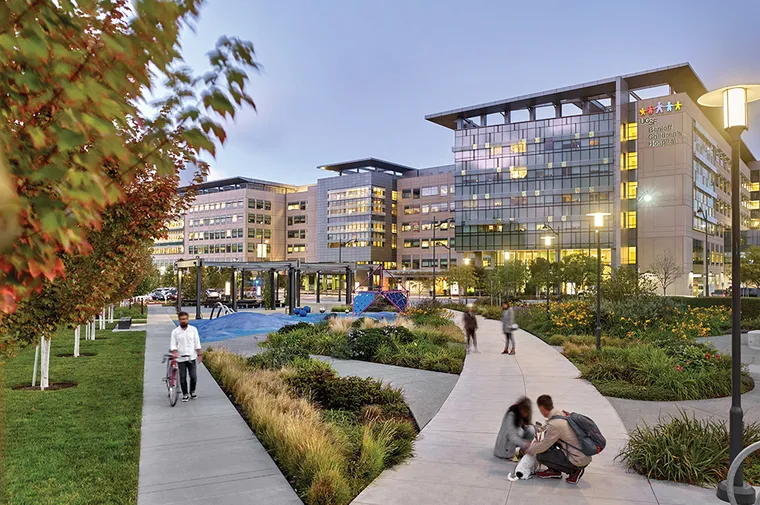
Photos: Courtesy of WRT

Understand The Site

According to CCLR and WRT, the first thing any successful parks team should do is gain a solid understanding of its site. That includes size, topography, access, utility service, vegetation, soil composition, local community perspectives, and adjacent land uses. Most grant applications require a clear, well-defined project vision that responds to the unique characteristics of a site and community. In short, a solid plan will set a community up for future success.

The Bothin Marsh Open Space Preserve in Mill Valley, Calif., relied on a 2019 Geomorphology, Ecology, and Conservation Options Report to outline restoration and conservation priorities for tidal-marsh ecosystems native to the North San Francisco Bay. Due to sea level rise, the preserve's bike and walking path is increasingly under water. The Golden Gate National Parks Conservancy and Marin County Parks are planning improvements to keep this open space accessible and sustainable.  

This phase is also the time to involve local communities. Project success requires robust engagement over time, plus many grant applications will ask for proof of community involvement. In planning adaptations at Bothin Marsh, planners worked with two dozen local agencies and organizations and 450 community members. Community engagement showed enthusiastic support for plans to restore an elevated trail and buttress marshland susceptible to erosion from rising tides. In 2024, the Conservancy and County received a $1.7-million grant from the San Francisco Bay Restoration Authority to support additional planning and engineering. 


Identify, Stack, And Sequence Funding

Often, large grants provide significant investment at critical points in development, and municipal funding tools finance construction and sustain long-term park operations. “Sequencing and stacking is a strategy to outline which sources can be used simultaneously, to maximize your funding across all phases of the project,” says Fingerhood.

Groveland, Calif., demonstrated how small local investment can also help secure grant funding. The team sequenced an initial $15,000 municipal, general-fund investment in concept development and engagement with an additional $70,000 for grant application support. The project went on to win $1 million through the Clean CA Local Grant Program and $5 million from the Caltrans Active Transportation Program. 

Funding challenges often hit hardest when there’s no clear financial strategy and limited institutional capacity. The best way a funding team can overcome this is through preparation. The more clearly leaders define desired outcomes and back them up with strong data, the better positioned they’ll be to identify and secure high-potential funding opportunities.


Secure And Manage Funds

According to Let’s Create a Park, getting funded—whether through grants, bonds, donations, etc.—requires careful planning and attention to detail. While casting a wide net can be beneficial, CCLR recommends against getting tangled up in opportunities that aren’t a good fit for a project. After thorough research, focus efforts on high-potential opportunities. 

And securing funding is just the start. Leaders will need to have a good sense of any mandatory oversight or reporting associated with their funding streams. For example, many grants come with strict compliance requirements and deadlines that can strain smaller teams. Thankfully, support is out there. Take advantage of cost-free technical assistance provided by grant-issuing agencies, find a consultant, or consider grant-management training to ensure the team successfully manages its funds.

Whether a project’s footprint is a 1.7-acre lot or 13 miles of post-industrial shoreline, Let’s Create a Park provides actionable steps to access diverse funding without overburdening a team’s limited resources.   

The following are a few places to start if locals are dreaming of a place to get out into nature, play in the mud, lie in the sun, breathe fresh air, have a barbecue, host a community meeting, start a run club, read a book, make a friend, or get involved in ecosystem preservation: