Rethinking Accessibility Projects

Rethinking Accessibility Projects

Signed into law 35 years ago, the Americans with Disabilities Act (ADA) prohibits discrimination against individuals with disabilities in everyday activities, including recreation.

4 min read

On ADA’s 35th anniversary, it’s time to debunk “disproportionate cost”

Signed into law 35 years ago, the Americans with Disabilities Act (ADA) prohibits discrimination against individuals with disabilities in everyday activities, including recreation. Parks and recreation buildings and spaces, such as community centers, athletic facilities, public parks, and more, are intended to facilitate leisure, entertainment, and recreation for all residents, and play an essential role in maintaining and enhancing the quality of life for entire communities. 

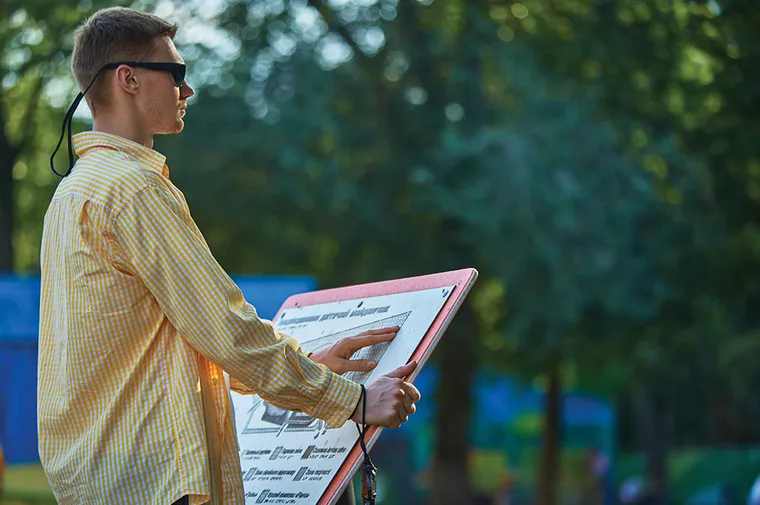
However, only 52 percent of people say their local parks are accessible to all. It’s not surprising, given a significant portion of parks and rec buildings and spaces predate the ADA. Even facilities constructed post-ADA are often not optimally accessible. Common issues include physical barriers (for example, pathways and trails lacking smooth, even, accessible surfaces for wheelchairs and other mobility aids); communication barriers (like lack of braille signage, audio descriptions, and assistive listening devices); and inadequate facilities (such as outdated bathrooms, lack of adaptive playground swings or picnic areas, and tables that don’t accommodate wheelchairs). 



Unfortunately, cities and municipalities across the country are notoriously strapped for the funds necessary to make critical updates. According to the latest estimates, America’s national parks are facing more than $23 billion in deferred-maintenance costs, with the average park agency carrying an estimated $16.5 million-backlog. Costs for commonly used maintenance materials and equipment—steel, lumber, playground parts, asphalt, bathrooms, and trees, for example—have increased with inflation, making the situation even more difficult. 

While grants and private-sector partnerships can often defray some of the initial planning, construction, and landscaping costs, these solutions rarely extend to long-term care needs, like irrigation and erosion prevention, tree and garden maintenance, equipment updates, and pest control, to name a few. Against this backdrop, accessibility improvements often take a backseat because they are thought to involve costly infrastructure outlays.


Designing Without ‘Disproportionate Cost’

In the years following its signing, the ADA announced the “Disproportionate Cost” provision, also known as the “Readily Achievable” standard. This allows for an exception to the requirement of making alterations accessible when the cost of doing so is deemed excessively onerous for the property owner. Specifically, if the cost of providing an accessibility feature exceeds 20 percent of the total cost of an overall alteration project, ADA compliance is required only to the extent considered “feasible.” So, for example, a parks and rec department plans to update a building’s public bathroom at an estimated cost of $40,000. Any accessibility-focused feature costing in excess of $8,000 would not be mandated, provided the owner fully exploits all other “reasonable” measures to ensure usability.

The great news is that simple design changes can now be made without triggering disproportionate costs, with public bathrooms in particular providing an abundance of opportunities. This is important because everyone deserves the right and dignity of using a public bathroom independently, including washing hands.

Photo: © Olha Kachur | Dreamstime.com

Identifying these opportunities may require parks and rec agencies to be more contemplative and resourceful, especially when trying to cost-effectively meet the needs of different groups of people. Bathroom sinks, for example, must be high enough for wheelchairs, scooters, and other mobility devices to be able to slide beneath, but they must also be reachable for persons with certain disabilities (like achondroplasia, the most common form of dwarfism).

One option is installing dual-height fixtures, although these can be expensive and possibly space-prohibitive. A more cost-effective plan may involve installing a retractable step-stool that affixes to the ground in front of the sink and can easily be folded and stored when not needed. Inspired by their school administrator with achondroplasia, an enterprising group of sixth-grade students in Ottawa recently petitioned the city council and spearheaded an initiative to have such stools installed in the local public skating rink.


Other examples include raised toilet seats, which are readily available at low cost and make it easier to sit down and stand up, benefiting both the elderly and the mobility-challenged. Also, lever-style handles on doors require less grip strength and are easier to operate than traditional doorknobs—a welcome accommodation for those with arthritis and other hand and nerve conditions, as well as for small children. 

The best part about small changes like these is they tend to be universally beneficial, enabling a better user experience for all. In the step-stool example, not only do persons with certain disabilities benefit, but so do those without physical impairments, like small children and their parents, who no longer have to awkwardly hoist their youngsters over the sink to wash their hands. According to one study, over half of parents deliberately choose to visit public facilities that feature kid-friendly bathrooms.

The ADA’s 35th anniversary is a great time for parks and rec agencies to reflect on ongoing accessibility efforts, which are never “one and done” and always have room for improvement. The next time accessibility updates are proposed, leaders should avoid taking cover behind the disproportionate-cost clause unnecessarily. Instead, they should follow the example set by others, think outside the traditional box, consider all options, and focus on what’s important—promoting inclusion and equity, and ensuring everyone can experience the far-reaching physical, mental, and social benefits of these national treasures.