
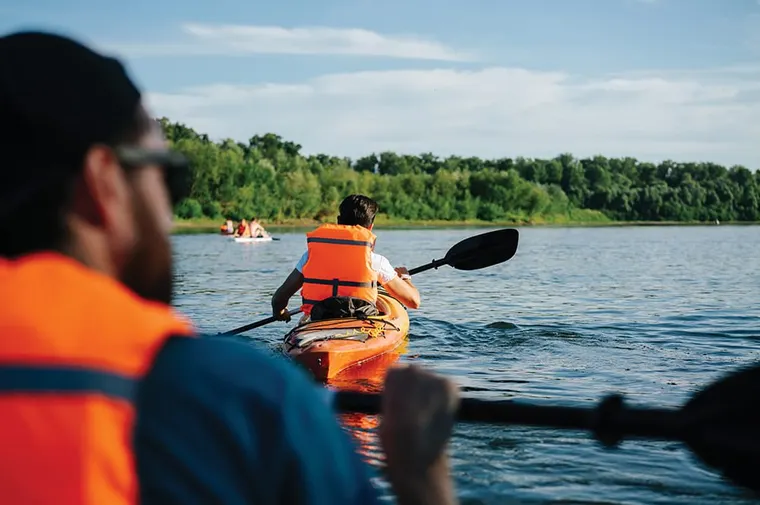
Help guests be safe during waterfront activities
By Greg Schmidt
Before patrons arrive at your facilities to enjoy the warm weather and spend time in a lake or other body of water, you can share certain skills with them on how to be safe. Here is some advice from an old pro in water safety on how to make the most of these activities.
Strong Swimmers Required
First, one must be a competent swimmer to be truly safe. Generally, this includes the following:
- The ability to jump into water that is too deep to stand in, without fear.
- The ability to surface, level off, and assume a comfortable swimming position, either prone or supine.
- The ability to return to a shore, dock, or boat without struggle.
- The ability to tread water for two minutes without struggling.
Note—competent swimming does NOT equal a crawlstroke/freestyle. Although the crawl is the most commonly used swimming stroke, it is certainly not the easiest to perform. That stroke is winging and kicking (also called combined stroke on the back). This is the first stroke most effective swimming instructors teach students. Why? It provides a return to shore/safety with minimal coordination and practice. Winging is the act of flapping the arms at one’s sides like a bird, but pushing the water towards the feet with the palms of the hands. Arms must bend at the elbows and kept close to the body to reduce drag and increase the efficiency of the arm stroke. Both arms should move in a simultaneous pattern. The kick is a flutter kick, which can be effective in keeping the hips up if the kick is slightly submerged and the legs are fairly straight.