
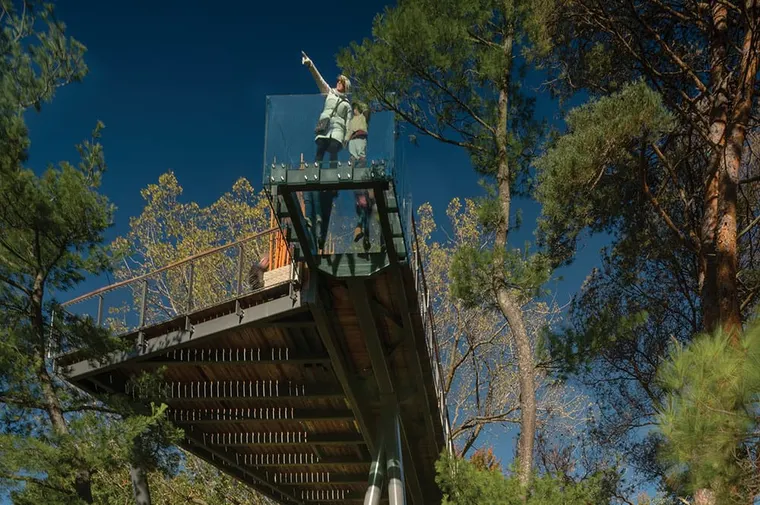
Whiting Forest provides a memorable experience that fosters intergenerational interaction
By Alan Metcalfe
As parks administrators—and parents—know all too well, children are plugged into electronic devices and tuned out of “live” action for too many hours in the day. The quintessential childhood experience of running out the back door and spending the day outside has largely disappeared, as have other critical developmental processes: group socialization, physical fitness, competition, and just plain play.
Thoughtfully designed outdoor spaces like Whiting Forest of Dow Gardens in Midland, Mich., offer an alternative to today’s overconnected world. In contrast to the typical playground filled with off-the-shelf recreational equipment, these spaces use the outdoors to create an interactive environment. By generating excitement, the perception of risk, and challenging group activities, the design for this park encourages kids and their families to interact directly with nature and each other. It’s a place of discovery. Unscripted social and nature games and hands-on nature experiences provide opportunities for youngsters to take control of their environments, set their own challenges, assess their own risks, take their own responsibility, have their own adventures, learn from all these experiences—and, most of all, to have fun without being told how.
A too-common mistake in park design is environments that are totally focused on kids—to the exclusion of adults. Appealing to entire families—not only young children—is key. If parents or grandparents are relegated to being mere playground observers, they aren’t going to jump at the chance to pay a return visit to a park. And if teenagers aren’t enticed by what the facility has to offer, they’ll opt out as well. Featuring memorable experiences that foster inter-generational interaction will make repeat customers out of one-time visitors.
The highlights of the Whiting Forest installation include the longest tree canopy walk in the United States, a 13,000-square-foot nature play area with child-scaled furnishings and play structures, an amphitheater, and a forest classroom. Terraces and bridges connect these features, with a restored mid-century modern house repurposed as the visitor center, which acts as a hub for the various activities.