
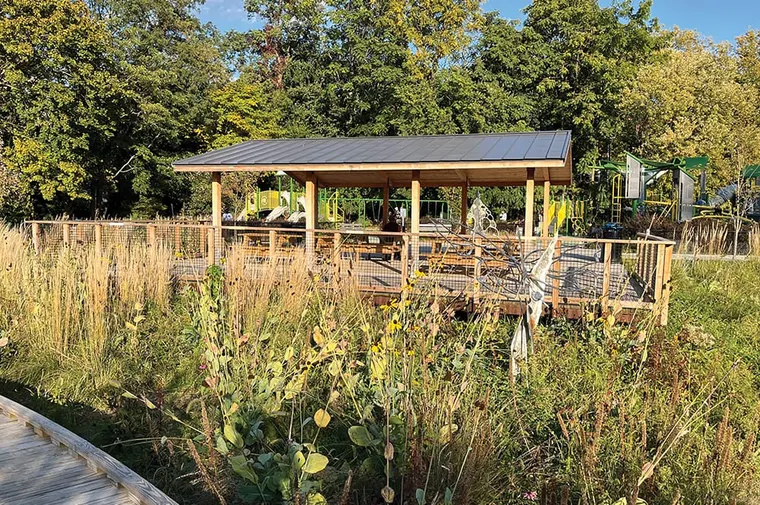
Wightman Park serves as a model for integrating stormwater and recreational needs
By Sara Thompson
To make cities more resilient, park planners and designers need to look beyond the typical stormwater requirements when thinking about public spaces. How can parks solve larger, community-wide stormwater problems while still accommodating recreational needs? Located in the Squirrel Hill neighborhood of Pittsburgh, the two-acre Wightman Park takes about 30 acres of runoff from the neighborhood and uses most of the site’s square footage to capture more than 400,000 gallons per storm event. To accommodate this larger stormwater capacity and help reduce local flooding issues, multi-layered and multifunctional spaces were designed. A highly collaborative process led to additional funding and a successful project partnership between the city of Pittsburgh Department of Public Works (DPW) and the Pittsburgh Water and Sewer Authority (PWSA). The result is a park with layers of functions, where green infrastructure is truly integrated within recreation, becoming part of the user’s experience.
In 2014, Pashek + MTR was hired by DPW to develop a master plan. The park is surrounded by mostly single-family homes with a few multi-family unit apartments, a CVS pharmacy, office space, and the Carriage House, home to a childcare facility and several non-profits. The park included a T-ball field, basketball court, and a playground that needed replacement. During the master-plan process, it was discovered that the park was the site of a former stream, and a good portion of the neighborhood drained towards the park. The company also learned through an extensive, public-engagement process that many neighbors were having difficulty with flooding and basement backups.