
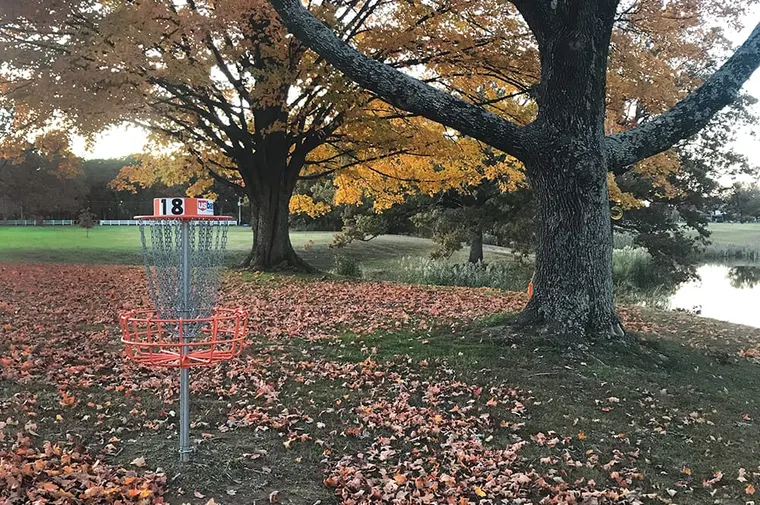
Make informed decisions when designing a disc-golf course
By Bob Carver
According to the Disc Golf Association, there are more than 2,500 courses in the United States and another 1,500 around the world. The association reports it has more than 87,000 members, and in 2019 there were more than 3,000 sanctioned disc-golf events in this country. As a casual sport, disc golf draws millions of people of all ages.
As a result of this growth, many parks are considering the viability of having a course in their communities. Here are some of the top questions to ask:
How much property is needed to construct a course?
As a rule of thumb, a minimum of 20 acres is a starting point for development. It is not unusual for a disc-golf course to share property with other common park elements, including trails, ball fields, playgrounds, and picnic areas. While these areas can be shared, safety is a key factor. For example, never throw a disc across a trail unless there is reasonable visibility in both directions; however, a disc-golf hole can be parallel to a trail. A disc-golf tee can be near a playground, but placing a basket nearby is out of the question. Obviously, one cannot send discs across recreational fields, but the perimeter of non-used areas works well.
Are elevation changes necessary?
Elevation changes on a course are helpful and often desired. It breaks up monotony and adds an element of challenge since many shots may be blind—both in the fairway and at the site of the basket. Some courses are placed in areas that are almost impossible to play without climbing gear. They may be fine for goats—or for a small number of players who love the danger—but for the average person, care should be used concerning extreme elevation changes.