How We Do Things Everywhere

How We Do Things Everywhere

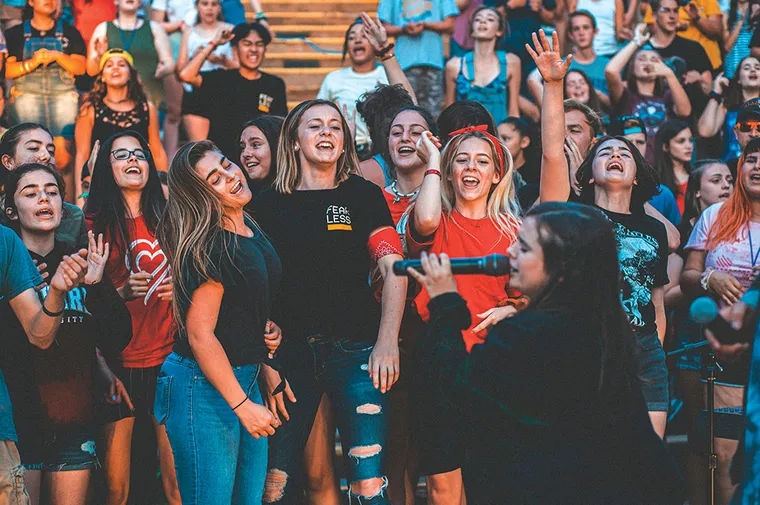
In a rainbow barn packed with a hundred campers and forty counselors, a 16-year-old CIT with electric-blue hair performed what felt like the final poem of her childhood.

5 min read

Camps balance fun and growth — but change is harder

In a rainbow barn packed with a hundred campers and forty counselors, a 16-year-old CIT with electric-blue hair performed what felt like the final poem of her childhood. Tear-streaked but smiling, she addressed Laura Kriegel, the founder of Camp Stomping Ground, directly: “There is a version of myself that is only for you. And for this place.” 

This was the fifth camp I had visited, and nearly my hundredth day away from home. My summer had been so saturated with hidden curriculum—unspoken customs, bizarre rituals, indiscernible lingo—that I had surrendered to ignorance, discomfort, and unfamiliarity. But I recognized that girl, that feeling. It’s the medicine; it’s the magic. The fire and the glue. It’s being part of something special and bigger than oneself. It’s growing up, away from home, under the sky, together, just for a little while, but somehow forever.

At my childhood camp, Camp Sloane, we used to stand in a triangle and say, “It’s not goodbye; it’s see you later.” At Stomping Ground, we form a circle, interlock pinkies, and exclaim, “It’s good to be together!” At Camp Champions, another stop on my fellowship tour, we sit in rows and declare, “We can! Do hard things!”

These are the intimate times—interconnected, reflective, usually in the dark. Camp people joke that they’re the “culty” times, but if I learned anything last summer, it’s that dogma oozes from every corner of the American summer camp. The real “culty” times are the quiet moments between directors in the camp office, when something isn’t working, when something should change, but doesn’t.


Hiddy Cricks

I applied to the camp career accelerator for exposure and direction. I loved camp as a kid, a counselor, and in seasonal leadership roles, but I didn’t understand it as an institution. I set out to learn how camps are built or bought, how they’re maintained, both culturally and financially, and to collect as many strong ideas as possible. I packed my summer with a wide spectrum: overnight and day camps, for-profits and non-profits, one-week sessions and seven-week marathons, and a camp for kids with autism. I thought, If camps do good, how could I help them do the best? After one week, I suspected I could not. Doing good would have to do.

The oldest surviving summer camps are nearly 150 years old. And, regardless of a camp’s founding year, every tight community embedded in nature carries that olden quality. At Camps Kenwood and Evergreen, the Taps bugle call still sounds each morning, though now it’s only a recording. Summer camp is a heaping pile of traditions, and tradition is sticky. It’s what keeps people around, but then it won’t come off in the shower.


Unless a camp is getting re-accredited or hosting a tour that day, there are no true outsiders at camp. Or camps turn outsiders into insiders so quickly that no one quite remembers the transition. For the first 48 hours of the camp session, buy-in is the name of the game. Camp has to feel both safe and fun before it can really work its magic.

For the past decade, Jack Schott has trained thousands of staff on unpacking that “hidden curriculum” to build trust. The phrase is now so common in the industry that, across the country, I heard it referred to as “hiddy cricks.”

I, however, was uniquely positioned to maintain outsider status all summer. It’s hard to fully buy into a camp’s culture when you know you’re going to leave in the next few weeks, and when part of your job is to observe the buy-in process critically. And, from the outside, flaws are more obvious. First-year counselors certainly notice when something at camp is clunky, boring, or stressful, but there are countless barriers to remove, including and especially the phrase, “This is how we do things around here.”

I was meant to collect data points to use one day at my own camp, but each time I saw a better way to handle staff training, check-in day, or evening med call, I wanted to share it with other camps. And no one wanted to hear it. Conversations with longtime returners kept stalling at the same dead ends:

“We’ve done announcements in the dining hall since I was nine.”

Photo: © Juan Moyano | Dreamstime.com

Imperfect Reflection

Maybe I had been watching too much Couples Therapy, but I was unsettled by how near our childhoods still felt, and how consciously and deliberately we all endeavored to relive them in our work. It was especially confusing to feel so bogged down by legacy when the average camp professional is a creative problem solver—a progressive dissenter in the outside world. The catch-22 of building something great is that once you’ve decided it’s great, you stop questioning it, and the impact gets buried under the intention. Camps are better than ever at unhiding the curriculum, but still just as rigid about rewriting it.

Camp is fraught with paradox. Kids are the mission, but their parents are the real clients. They preach inclusivity, but no club is more exclusive than “lifer.” In her book, History of Organized Camping, Eleanor Eells writes that camps have always been both escapes from reality and reconfirmations of it. So, is the “version” of that blue-haired girl that emerges at camp her truest self, or someone else?

At the 2022 ACA Tri-State Conference, Simone Gamble asked whether camp is a utopia or a microcosm of our world. We didn’t reach a consensus but did unanimously agree that camp is more loving and just than the real world. However, that raised the question: When camp ends, are kids more or less able to face that world? Are we offering them refuge or a false promise?


Camps almost always promise fun and growth, which are challenging to balance (growing doesn’t feel fun). The camps that lean toward growth are suspicious of “coddling”; those that lean toward fun are suspicious of “grit.” It always comes back to how we were raised. How we do things around here.

I was deep in the camp-contradiction trenches, lost in my own philosophies about childhood development, and afraid that they, too, would eventually devolve into dogma. Then, I heard that girl’s poem and remembered the most obvious facet of summer camp: it works.

Camp passes down its contradictions, like the real world does. But children do transform there, and always take something home—resilience, confidence, perspective, joy. Whether it is despite or because of traditions, camps turn out champions, leaders, radically empathetic problem-solvers, dissenters, and best friends. Maybe paradox is the point—it holds the line.

There is a version of our world that exists only at camp; it is an imperfect reflection.