
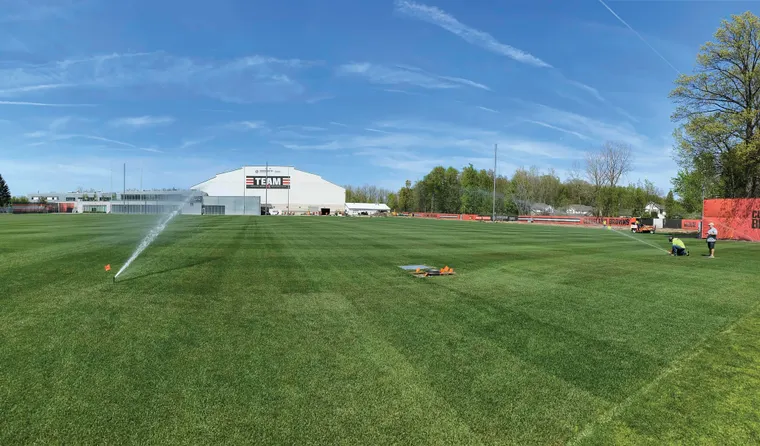
Why these complex subjects are anything but cut-and-dried
Irrigation (and subsequently, drainage) are some of the most important topics in sports facilities, but they often receive the least attention.
Maybe it’s because they’re not as exciting as a new set of lights or upgraded Wi-Fi. Maybe it’s because most people don’t understand them very well, and as a result, avoid paying attention to them.
The problem, however, is that avoiding this particular topic will set up sports facilities to fail. After all, it doesn’t matter how great the Wi-Fi is if the field is a muddy mess. And if tennis, pickleball, or basketball courts have puddles of water that gather dirt and become slippery, all the lighting in the world won’t help.
The following is a primer on irrigation and drainage and how one can harness them to put sports facilities on the path to success.
For Courts
First, the basics. Most courts in park and rec installations have hard surfaces (made of concrete or asphalt and covered with sport-specific acrylic surfacing).
Proper drainage for these courts starts with the correct slope, which, according to the publications Tennis Courts: Construction & Maintenance Manual and Pickleball Courts: Construction & Maintenance Manual, should be one inch in 10 feet with a permissible maximum of one percent. (More than this is bothersome to players.)