
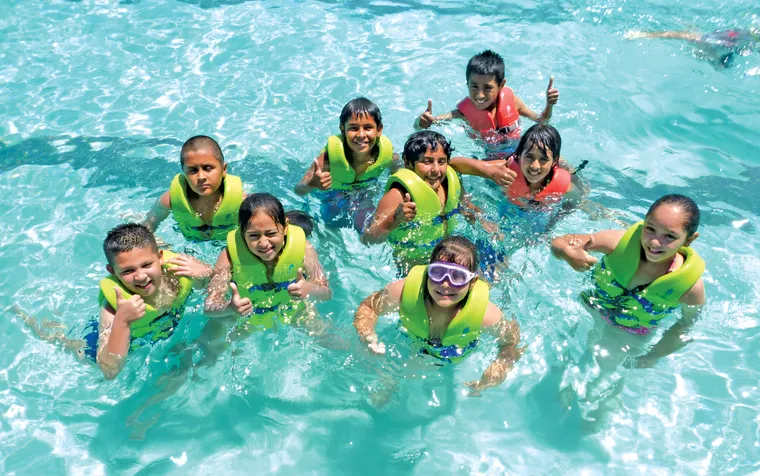
The Note and Float Life Jacket Fund boosts water safety with life-saving donations
Nearly two decades ago, the Note and Float program was created by Dr. Tom Griffiths while he served as the Director of Aquatics at Penn State University. The program is a free drowning-prevention strategy for facilities to adopt, identifying weak and inexperienced swimmers, and requiring them to wear U.S. Coast Guard-approved life jackets. The program was piloted at Penn State. Beautiful life jackets in different pastel colors and sizes were displayed on a rack at the entrance of the Penn State Natatorium. In front of the rack was a 48” Note and Float logo children could use to measure themselves, or parents could use to help measure children, akin to a “you must be this tall to ride” sign at amusement parks. Non-swimmers and those under 48” were required to wear U.S. Coast Guard-approved life jackets.
The program made a big splash. Thousands of children, including those attending sports programs and other camps, donned the colorful jackets. Across the nation, some swimming pools adopted the full program, “Noting and Floating” kids at their facilities. Others partially adopted the program, using life jackets for events, parties, and other groups using a facility. And, yet for others, the program served as a reminder to simply have life jackets available at a facility, even if children were not required to wear them.
One decade ago, the non-profit organization Note and Float Life Jacket Fund was created. The aim was to fulfill a need, closing the gap between facilities wishing to implement Note and Float and those lacking enough funds to purchase life jackets. Thus, the mission of the fund was simple from the start. Facilities apply for life jackets to float non-swimming children. From the applicants, facilities are chosen each year, receiving life jackets for their facility.