
Two potentially different outcomes
By Paul Duffy
On a hot summer day, a woman collapses near a baseball field. Bystanders jump into action and quickly realize she isn’t breathing and has no pulse. Someone calls 911 and others begin CPR. The dispatcher asks if there is an Automated External Defibrillator (AED), but no one knows.
Seeing the commotion, employees at a food stand say they have a defibrillator, but it’s locked up. They begin frantically calling the manager, who, of course, isn’t working at 7 p.m. on a weekend. The ambulance and first responders arrive 10 minutes later and take over CPR. Those 10 minutes can seem like a lifetime when you’re trying to save a life. And those are common response times, from the biggest cities to some of the smallest rural communities across the country. But more important is that early CPR and defibrillation in those 10 minutes can dramatically change the outcomes for victims.
Take Two
This story plays out almost daily across the United States, but it doesn’t have to end the same way. Let’s see how it can play out differently.
The same woman collapses by a baseball field.
When a bystander calls 911 to report a cardiac arrest, the dispatcher asks about their location in the park.
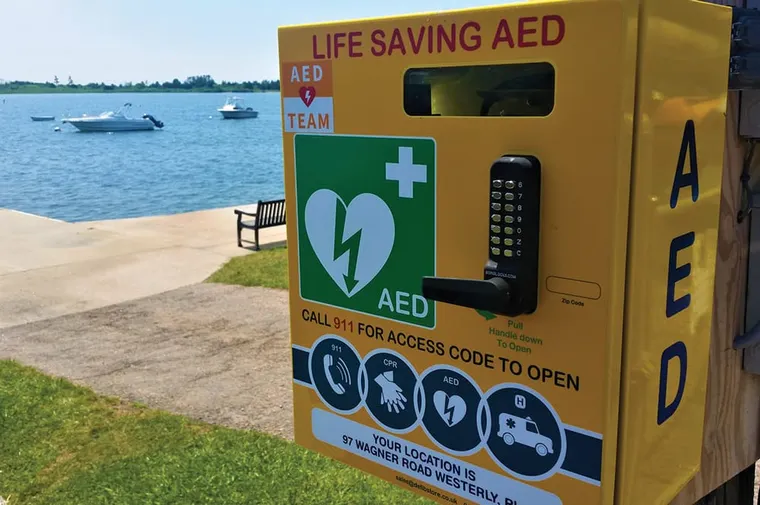
Dispatcher: “Ok, help is on the way. I need you to go to field R2. There’s a bright yellow box by the dugout with an AED in it. Tell me when you get there.”
911 Caller: “I’m here.”
Dispatcher: “Ok, push 1789 into the lock box code, take out the AED, and bring it back to the victim.”
Within five minutes of the woman collapsing, the defibrillator is attached and a shock is given.
Five minutes later, the ambulance arrives. There are 10 minutes for both scenarios, but potentially dramatically different outcomes for the victim.