
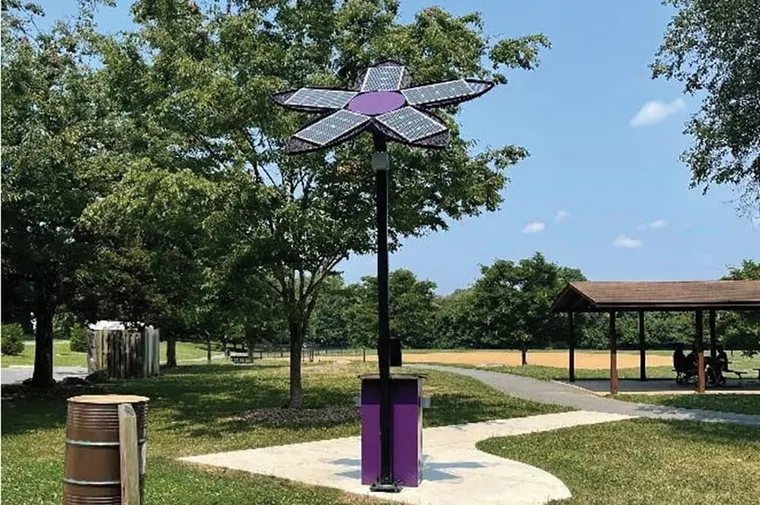
Provide a lifeline for patrons to access electronic devices in remote areas
By Parviz Izadjoo
Solar-powered charging stations are becoming more visible in public areas—especially where there is no access to power lines. The stations are frequently used to charge mobile devices such as laptops and phones. Mobile phones, also known as “smartphones,” are among the most sophisticated electronic devices ever built and are gradually evolving into mobile personal computers.
However, a major shortcoming with mobile devices is the battery’s storage capacity. No matter how powerful and versatile a device, once the battery is drained of power, it is rendered useless. Therefore, having access to charging stations, whether indoors or outdoors, is critical. Unfortunately, installing charging stations where power lines are not accessible poses a serious challenge with limited and costly solutions.
Many companies offer solar-powered charging stations that vary in size and design based on users’ needs. Therefore, anyone planning to purchase a solar-powered charging station should consider:
· Number of users at any given time
· Types of devices to be charged
· Location
· Potential for vandalism
· Aesthetics
· Need for a seating area
· Adequate sun exposure
· Accessibility
· Size of battery
· Safety.
The Facilities Management Division of The Maryland-National Capital Park & Planning Commission explored different approaches to providing charging stations for park patrons. In a review of many of the available options in the market, it was determined that none of them would work for the division’s needs. Particularly, since the charging station was for a park setting (in addition to its appropriate technical specifications), it had to be in harmony with the natural setting. Therefore, the goal was to design and build a solar-powered charging station which not only can technologically fulfill the needs of park patrons, but also look aesthetically pleasing and iconic.