
How to plan maintenance like a capital project
By J. Ryan Casserly
Every aquatic professional knows the sinking feeling of a pool closure. Members are frustrated, schedules are disrupted, and budgets are drained by emergency fixes. Too often, maintenance is reactive, something done only when equipment fails.
What if leaders approached maintenance with the same discipline as that in a new build? A yearlong schedule, clear milestones, and budgets aligned with predictable needs—that is the philosophy behind AquatiCare, Landmark Aquatic’s proactive maintenance program. Instead of waiting for problems to arise, AquatiCare delivers a 12-month playbook that transforms maintenance from a liability into a strategic advantage.
The Cost Of Waiting Until It Breaks
Unplanned breakdowns hit facilities in three ways:
Direct costs are the result of expedited shipping, overtime labor, and premium emergency parts.
Indirect costs derive from lost member trust and disrupted schedules.
Lifecycle costs come from premature equipment failure caused by neglect or miscalibration.
One example: In benchmarking, a single weekend pool closure can cost $8,000 to $15,000 in refunds, lost programming, and overtime.
A Playbook Approach To Maintenance
Capital projects succeed because they are scheduled and disciplined. Maintenance deserves the same treatment. The AquatiCare playbook organizes the year into quarters of focus, each tied to predictable operational rhythms.
Q1: Inspection and Planning Season (January—March)
The year begins with a full system audit. Filters, pumps, heaters, and controllers are evaluated in detail. Condition assessments use vibration, flow, and pressure data to identify early signs of wear. Chemical feed systems are calibrated to reduce waste. Every finding is documented in a digital dashboard with action priorities.
Quick Checklist For Q1
- Inspect filters and mechanical seals.
- Calibrate dosing pumps.
- Audit HVAC units.
- Align the maintenance budget.
Q2: Prep And Upgrade Season (April—June)
Spring is the window to prepare for peak season. Filter media is replaced before the crowds arrive. Dehumidification and HVAC systems are calibrated for heavy summer use. Digital controllers receive software updates. Accessibility features such as lift chairs and ramps are confirmed for compliance.
This is also the time to tackle small capital upgrades. LED lighting retrofits, updated chemical monitoring, or lane line replacements are completed now to avoid interruptions later.

Q3: High Use Monitoring Season (July—September)
During the busiest months, the focus shifts to real-time monitoring and quick adjustments. Sensors track flow rates, chemical usage, and temperature. Weekly spot checks confirm digital readings. Small fixes, such as tightening valves and lubricating seals, prevent major breakdowns.
Q4: Reset and Rehab Season (October—December)
After peak use, facilities take time to reset. Heat exchangers, gutters, and surge tanks receive deep cleaning. Grout, finishes, and lane lines are repaired. A year-end analysis compares actual costs to the budget and refines the next year’s playbook. For competitive facilities, this is also the season for performance upgrades such as recovery spas or timing systems.
The ROI Of Planning
Facilities that adopt a playbook approach see measurable results:
- They achieve a 20 to 30 percent reduction in emergency repair costs.
- They extend equipment lifespan by 15 to 25 percent.
- They reduce unplanned closures by as much as 40 percent.
Case Example: Blackhawk Amenity Center—A Community Hub That Elevates Everyday Life
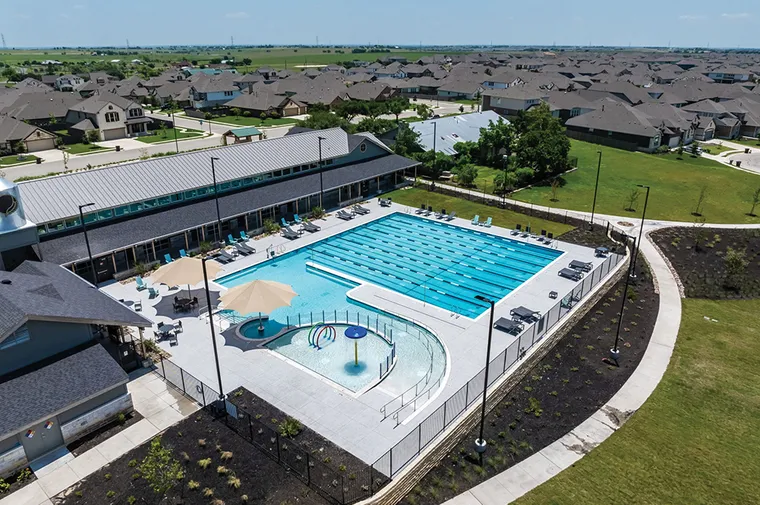
Located in Pflugerville, Texas, the Blackhawk Amenity Center was designed to be more than just a pool. It serves as a gathering place where neighbors connect, families play, and the community comes together.
With versatile spaces for relaxation, swim activities, and recreation, the facility reflects Landmark Aquatic’s dedication to creating environments that are both functional and beautiful.
The design includes a resort-style leisure pool, an eight-lane lap pool, ADA-compliant lift access, and both stair and ramp entries, ensuring the space is as inclusive as it is inviting.
The Blackhawk Amenity Center stands as a strong example of Landmark’s collaborative, design-build approach and its focus on crafting aquatic spaces that will enrich community life for years to come.
Building A Culture of Planned Maintenance
Technology is only part of the solution. Culture is equally important.
Staff members are trained to see inspections as prevention, not busywork. Avoided closures are celebrated as operational wins. City councils and boards are engaged with data that proves ROI.
In short, maintenance is not an afterthought. It is the project.
A Smarter Way Forward
Planning is not only for new pools. It is the lifeline of existing facilities. By adopting a 12-month playbook through AquatiCare, agencies protect budgets, extend the life of equipment, and deliver reliable service to their communities.
As operators, we owe it to our patrons not only to build state-of-the-art pools, but to keep them running reliably year after year.
J. Ryan Casserly is a seasoned executive with over two decades of leadership experience across the homebuilding, finance, and construction industries. Since 2015, he has served as Chief Executive Officer of Landmark Aquatics, where he has led the company’s evolution into a nationally recognized leader in aquatic facility design, construction, and service.