
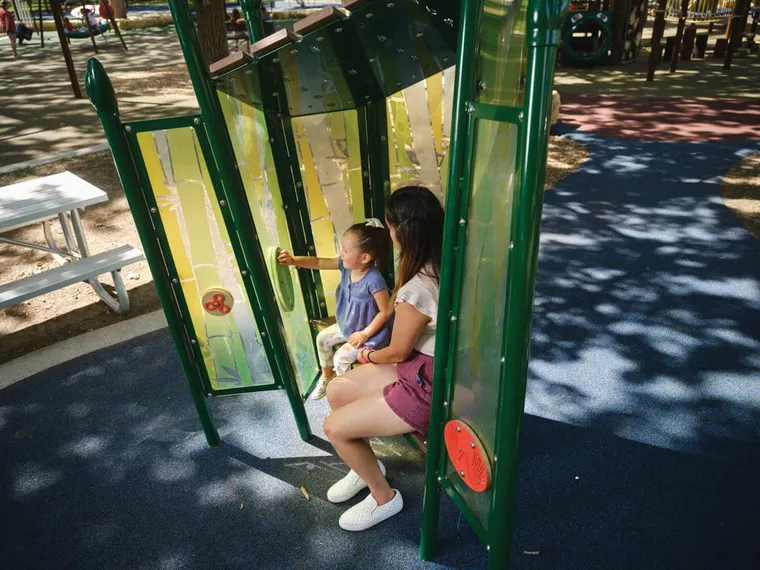
Most playgrounds were designed to pass code, not to serve every child
By Brandy Todd
In many playground-planning conversations, “accessible” and “inclusive” are used interchangeably. However, they don't mean the same thing. Accessibility is a compliance standard. Inclusivity is a design philosophy. One person asks whether a wheelchair can reach part of a structure. Another person asks whether every child, caregiver, and sibling who shows up can engage fully with every element of the space. Most playgrounds have only been designed to do one of these things.
The difference between “accessible” and “inclusive” matters more now than ever. Approximately one in six children in the U.S. has a developmental disability, and the prevalence of diagnosed developmental disabilities in children ages 3 to 17 rose from 7.4% in 2019 to 8.6% in 2021. Additionally, autism spectrum disorder alone affects about one in 31 children aged 8 years. These aren't edge cases or outliers that planners can afford to treat as afterthoughts. They are a substantial portion of children who show up at the playgrounds that communities are designing and funding today.