From plans to parks, identifying the neediest communities and ensuring ideas implemented
How should the value of a park plan be determined? Should a plan be judged by the degree to which it is implemented? What good is a plan if it offers a vision that is unfulfilled? These are the types of questions that many planners have wrestled with during their careers.
Planning is a key function of the Los Angeles County Department of Parks and Recreation (DPR), where I work as a park planner. My colleagues and I plan with equity and implementation in mind, ensuring that plans prioritize the neediest communities and do not end up sitting on bookshelves. Examples of such planning documents include the Los Angeles Countywide Parks and Recreation Needs Assessment and the Community Parks and Recreation Plans for various park-poor unincorporated communities.
Countywide Parks And Recreation Needs Assessment
The Countywide Parks Needs Assessment serves as DPR’s North Star, guiding its planning, resource allocation, and decision-making. Completed in 2016, the assessment was a historic undertaking to engage all of Los Angeles County in a collaborative process to identify and quantify the magnitude of need for parks in cities and unincorporated communities across the county and determine the potential cost of meeting that need.
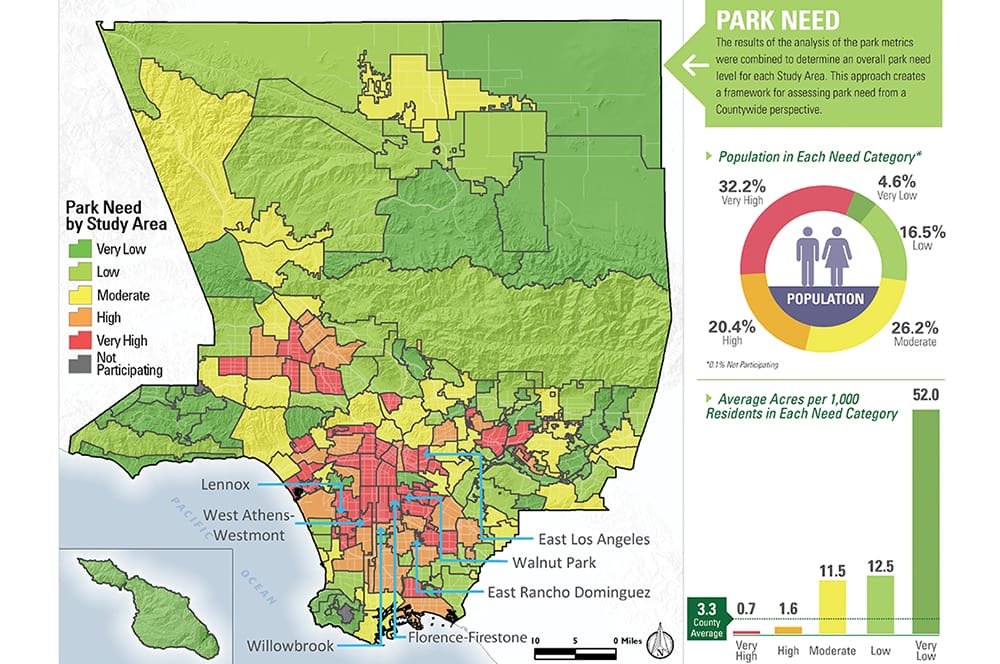
The assessment established a new way to understand and think about parks:
- Considering parks as key infrastructure needed to maintain and improve the quality of life for all residents
- Using a series of metrics to determine park needs
- Supporting a need-based allocation of funding for parks
- Emphasizing both community priorities and deferred maintenance projects.
The Parks Needs Assessment was equity-focused, and identified communities with very high or high park need—something that had never been done before. Knowing where these underserved areas are enables DPR to focus and prioritize resources to specifically address park inequities. The findings of the assessment were so compelling that the L.A. County Board of Supervisors decided to put a parks-funding measure, Measure A, on the ballot in November 2016. Due in large part to an extensive community-engagement process for the Parks Needs Assessment and an effective dissemination of public information, Measure A passed with nearly 75 percent of voters supporting it. Measure A generates about $95 million in revenue annually and has dedicated funding for very high and high-need areas.
Community Parks and Recreation Plans (CPRPs)
The first CPRP completed by DPR was for the unincorporated community of Florence-Firestone. In 2012, DPR applied for a Sustainable Communities Planning grant from the California Strategic Growth Council to prepare additional CPRPs to address the needs of six of the most park-poor communities in L.A. County: East Los Angeles, East Rancho Dominguez, Lennox, Walnut Park, West Athens-Westmont, and Willowbrook. Collectively, these communities are home to about 257,000 residents, or about a quarter of the population living in the county’s unincorporated areas.