
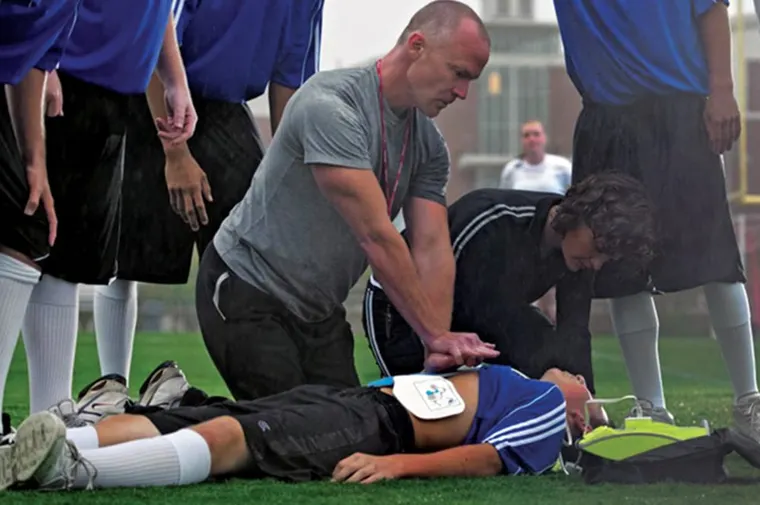
Prepare volunteers to step up if this life-threatening emergency strikes
Automated External Defibrillators—more commonly known as AEDs, with the letters and a red heart—are in almost every public place these days. As of 2017, all 50 states had some sort of law dealing with the placement of AEDs and 15 states specifically addressed athletic facilities.
Most people don’t realize that sudden cardiac arrest is the leading killer among participants in youth sports. But when you combine that with the knowledge that more than 300,000 people experience sudden cardiac arrest incidents every year, it’s fairly safe to assume that all 50 states will eventually have laws that require AED placement at athletic fields.
Obviously, having the devices available is a good start, but like everything else related to a youth-sports administrator’s job, one can’t expect to be everywhere at once. In most cases, if a cardiac emergency happens at one of your facilities, the use of an AED will most likely be used by a volunteer or spectator. That is why it is so important to have as many people as possible know how to operate this device. I have personally looked at one of those AED signs and thought, “I don’t think I’d be able to do that!”
But I was wrong.