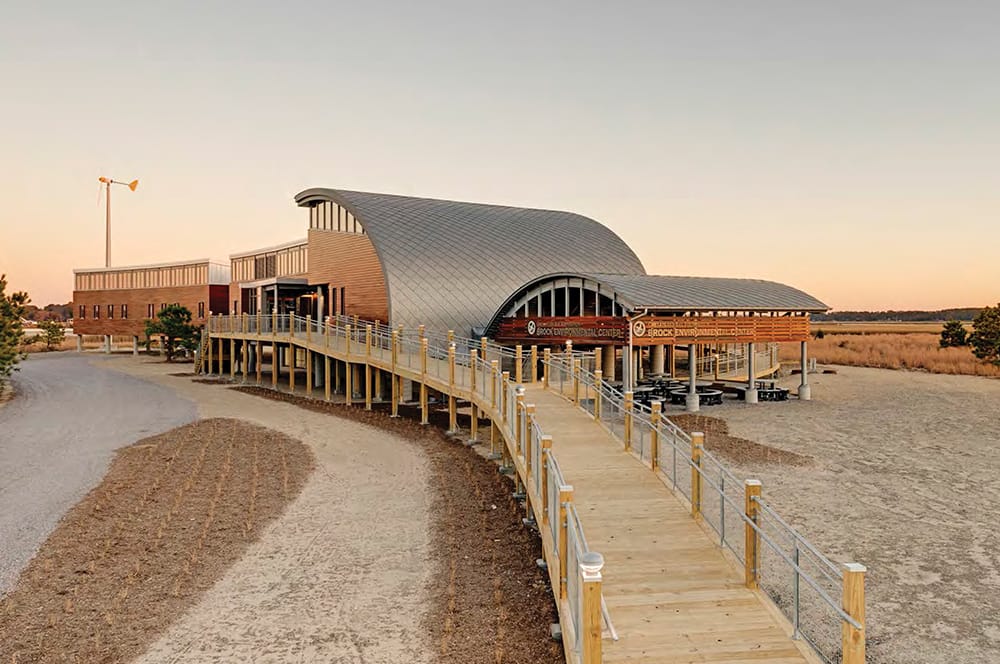
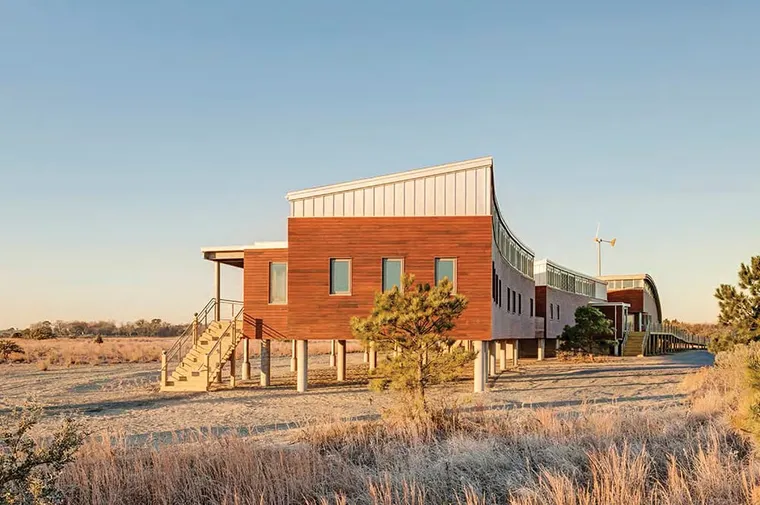
Brock Environmental Center reminds community why it’s important to conserve natural resources
By Kate Cerone
Finding the ideal site to construct a “living building” was no easy task. In 2001, the Chesapeake Bay Foundation (CBF) opened the Philip Merrill Environmental Center in Annapolis, Md., to educate the public about the importance of being good stewards of the Chesapeake Bay and the many wonders it holds, including critical species of fish, crabs, and oysters the region relies on. The CBF’s special history of conservation and environmental consciousness is a fitting background as Merrill Center became the first building in the world to receive the U.S. Green Building Council's Platinum rating for Leadership in Energy and Environmental Design (LEED), and the center continues to minimally impact its surrounding site. After construction of its successful headquarters in Maryland, the foundation envisioned a second location to involve and educate the bay’s community with environmental programs and a public meeting space in the Hampton Roads region, where the Chesapeake Bay meets the Atlantic.
On A Mission
CBF’s vision was a site that could house a net-zero energy building, where the total sum of energy used on an annual basis is approximately equal to the amount of renewable energy created on the site, while also conforming to the high environmental standards associated with the Living Building Challenge (LBC). After careful consideration, the undeveloped Pleasure House Point (PHP) property, consisting of 118 acres located west of the Lesner Bridge and south of the Chesapeake Bay, was purchased by CBF and the city of Virginia Beach in a joint effort to preserve the open space and the surrounding environment. With these goals in mind, the design team embarked on a highly iterative and consolidative process to meet the standards for LEED Platinum and the LBC. The team toured other LBC sites to formulate a shared vision for the project, which later became known as the Brock Environmental Center (BEC).
The project team aimed to achieve net-zero energy, net-zero water, and net-zero waste, which required a significant amount of research and preparation. LBC standards, called petals, include place, health and happiness, materials, equity, and beauty. To meet the challenges of the LBC materials petal, a “green” charrette, comprised of all design disciplines, local officials, community representatives, and subject-matter experts from the LBC/LEED field, was held on-site during the schematic-design phase. The client, architect, and contractor, as well as interns from local schools, developed shared online tools and formalized methodologies for construction-material vetting. The team partnered with the Center for Wind Energy at James Madison University to optimize the turbine design and with the U.S. Fish & Wildlife Services to ensure a bird-safe solution. Conversations with regulatory agencies began during early design and spanned throughout construction, enabling the project to maximize the use of rainwater for portable uses. The MEP and Building Enclosure Commissioning team were also engaged from early design throughout construction.