
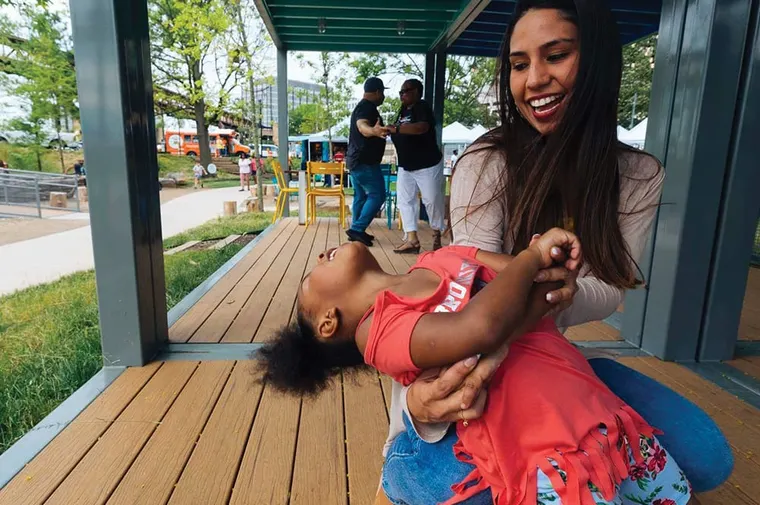
Strategies for bringing diverse people together through parks and recreation
By Bridget Marquis
Memphis, Tenn., is a city starkly divided by race and income, with a high poverty rate and few public spaces to be shared by people of different backgrounds. In 2016, a group of public and nonprofit partners decided to intentionally design, manage, and operate public spaces that would welcome people of all races, incomes, and backgrounds.
This collaboration has resulted in the transformation of a six-block area that contains a library, a trail, and two riverfront parks adjacent to downtown Memphis and along the Mississippi River. This area became the Fourth Bluff, a series of connected, vibrant, and dynamic civic spaces. One of the spaces was originally an uninspired, underused park along the Mississippi River named after Jefferson Davis (president of the Confederacy), but became the city’s River Garden.
Redesigned and reopened in late 2018, River Garden in a short time has become a go-to place in downtown Memphis. With the addition of a dining and events pavilion, all-ages play and adventure structure, natural meadow plantings, fire pits, a snack shack, swings, hammocks, tables, and differently scaled conversation spaces, it is successfully attracting more people than ever, with average visitor numbers up more than 300 percent since the transformation. Visitor intercept surveys demonstrate that the intention to attract diverse visitors is working: park users hail from a wide range of socioeconomic backgrounds and a geography of more than 40 different regional ZIP codes.