
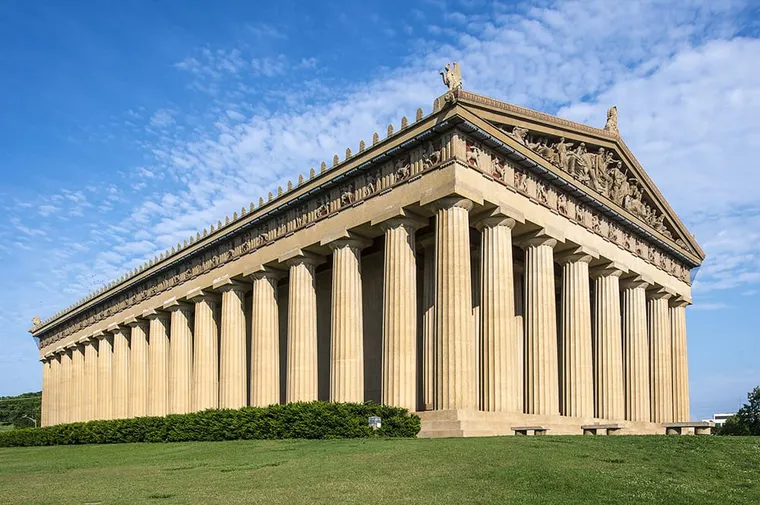
Nashville's Parthenon teaches lessons in history and civic engagement
By Nikola Krastev
In 2022, Nashville's Parthenon will celebrate its 125th anniversary. It is a blink of an eye compared to the age of the original Parthenon in Athens, Greece. Nevertheless, the city's iconic landmark has become a symbol of civic pride for residents and a monument of enviable architectural elegance and beauty.
History
The structure is the only full-scale replica of the original temple in Greece. It was erected for the Tennessee Centennial Exposition in 1897 as a temporary art structure. The decision to replicate the Parthenon was not random. Long before the building's scaffolds went up, Nashville had acquired the nickname, the “Athens of the South.” Ancient Greek, Latin, and classical literature were part of the curriculum in many of the city's public and private schools. The star of the 1897 show, the magnificent building has gained so many accolades that it was decided to leave it in place. When Centennial Park opened in 1903, the Parthenon naturally became its focal point. In 1920, the city's park board voted to keep it as a permanent structure. It opened as a museum in 1931 and currently hosts permanent and temporary art exhibitions and various cultural and educational programs. Apart from the country music scene, Centennial Park and the Parthenon arguably draw the largest share of visitors to the city. In 1972, the Parthenon was added to the National Register of Historic Places. Ten years later, the museum's upper level received some impressive aesthetic fortifications: a dazzling 42-foot statue of the Greek goddess Athena and replicas from the original Parthenon's pediment fragments.