
Why this timeless playground addition is worth the investment
By Julia Rousakis and Julia Ross
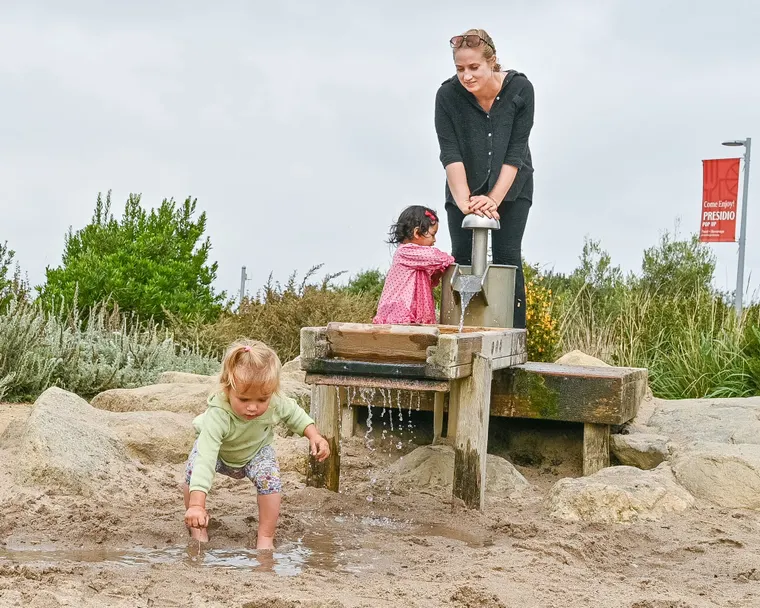
One sunny June afternoon, a dozen busy children gathered in the sand-play area of the Lubber Run Playground in Arlington, Va. Some dug tunnels, others built miniature mountains, and a few simply socialized, but everyone interacted with the tactile material. Parents relaxed on nearby benches or joined in.
Sand play “draws interest and activity and results in opportunities for creative play,” Lyndell Core, the Park Manager for Arlington County, says.
There are also headaches. “It’s a maintenance disaster,” Core says, as sand is carried onto stairs, creating potential slip problems. Such issues have led some play-space designers to forego sand altogether.
But play advocates urge planners and owners to carefully consider the value of the material for children and their families over the maintenance burden. “What is the point of the playgrounds we’re designing?” asks Meghan Talarowski, a landscape architect and play researcher with her firm, Studio Ludo. “Is this supposed to be a Disneyland, or is this supposed to be a sensory-rich experience that kids will continue to come back to?”
Starting With A Sand Pile
Today’s playgrounds can trace their origins to sand play. The playground movement grew out of ideas championed by child advocates in the 1880s. First, Friedrich Froebel, the German educator known as the father of kindergarten, introduced a movable sandbox in his “children’s garden.” The idea of using sand as a material for play expanded into “sandcastles,” or piles of sand. A Berlin-born doctor, Marie Zakrewska, brought the idea to the U.S., and in 1885, the first sandcastle was built in Boston’s North End. By 1899, Boston had 21 sand piles.
“Sand play is a timeless, universal outdoor activity that engages children from an early age,” says Nilda Cosco, a co-founder and the director of programs at the Natural Learning Initiative (NLI) at N.C. State University College of Design. “Its moldable quality invites digging, building, storytelling, and collaboration,” and inspires imaginative and constructive play. Its sensory qualities are great for relieving stress.
What’s more, sand play promotes self-determination. “Children are the designers here, and even though they are under adult supervision, they have more autonomy than within the fenced and labeled precincts of fixed equipment,” the pioneering child psychologist G. Stanley Hall notes in The Story of a Sand-Pile.