
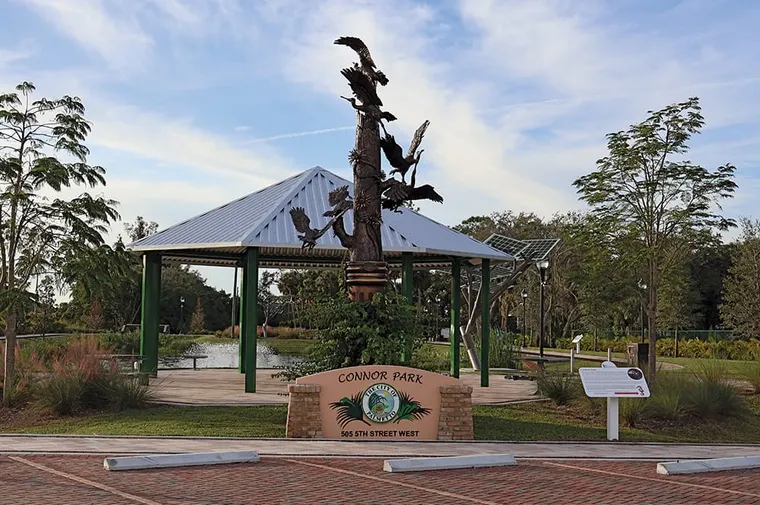
How a CRA turned contamination into climate infrastructure
Connor Park, a previously long-neglected, contaminated site, has been transformed into what is now a vibrant, public greenspace and stormwater eco-park in the heart of Palmetto, Fla. Previously a railway site and environmentally degraded area that posed both ecological and public-health concerns, the site was remediated and reimagined as a multi-functional public eco-park that now serves as a stormwater-management system, passive recreation area, and ecological habitat. Nationally recognized as a 2025 Phoenix Award Region IV recipient for its excellence in brownfield remediation and redevelopment, this feat was a multi-year effort, exemplifying how strategic investment and community-centered planning can revitalize underutilized land and improve the quality of life for residents.
Railroad operations have played an important role in the city’s agricultural and industrial economy, with the site having provided integral agricultural and industrial economic support to the region for decades. Over time, petroleum and arsenic contamination infiltrated the space, requiring detailed assessment, extensive environmental cleanup, and strategic investment to restore a once-abandoned site into an environmental asset that would improve water quality, restore ecosystems, and educate locals and visitors alike about Palmetto’s rich history.
Like many brownfield sites in small and mid-sized communities, Connor Park sat at the intersection of environmental responsibility, public access, and redevelopment pressure. The eventual transformation of the park was driven by statutory responsibility and practical decision-making rather than aesthetics alone. As I explained in a Bradenton Herald interview, “Our goal is to make sure that we can clean up these sites and turn them around. Either we’re going to make them open spaces, or we’re going to put them back on the tax roll.”
At Connor Park, that framework guided every major decision, from sequencing environmental remediation to determining the site’s ultimate public use. Rather than advancing a fixed design early, the agency prioritized environmental certainty, funding feasibility, and long-term maintenance considerations.
Establishing A Clear Redevelopment Mandate
Community redevelopment agencies (CRAs) are guided by a defined statutory mandate to address slum and blight, to strengthen public infrastructure, and to catalyze reinvestment within designated areas. Brownfield sites often satisfy multiple criteria for redevelopment, but environmental remediation alone does not ensure meaningful or lasting reintegration into the community.
For redevelopment agencies weighing brownfield reuse, Connor Park demonstrates the importance of clarity around end use. Its history dates to the early 20th century, having served as a railroad spur and freight yard before being acquired by the City of Palmetto in the late 1990s and eventually transferred in ownership to the Palmetto CRA shortly thereafter. For years, the property remained constrained by hazardous environmental conditions and limited viable-reuse options. Rather than advancing a predetermined land use, the agency focused first on environmental due diligence, site characterization, and feasibility analysis.
This approach allowed the redevelopment strategy to be informed by site conditions, hydrology, and regulatory requirements, rather than aesthetic or programmatic assumptions. Only after remediation pathways were established did the agency advance a public-use concept aligned with broader redevelopment goals.