
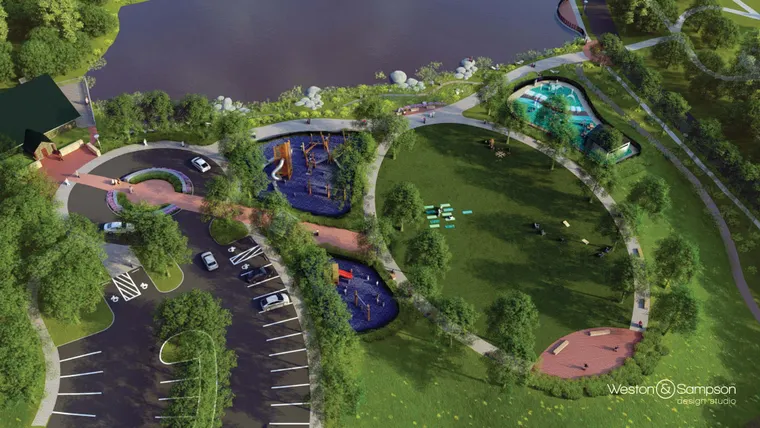
Renovating Page Park from the viewpoint of a young landscape designer
For a young landscape designer, the path from concept to completion is rarely straightforward. It’s a journey marked by uncertainty, unexpected obstacles, and constant adaptation. Seeing a design come to life in the field reveals just how profoundly site conditions can shape outcomes. These moments are eye-opening, transforming abstract ideas into tangible lessons. Through observation and problem-solving on-site, theory evolves into practice, and the true depth of landscape architecture begins to unfold.
The renovation of Page Park in Bristol, Conn., was the first project where I witnessed the entire design and construction process from start to finish, and the experience was truly transformative. Weekly site visits gave me a clear view of how design intent translates into built form and how important coordination, flexibility, and problem-solving are to the process. Seeing drawings move from paper to the field reshaped my understanding of landscape architecture as a practice that is grounded as much in observation and adaptation as it is in design.
Gifted to the city in 1933, Page Park spans 86 acres and offers a wide range of activities, including wooded trails, disc golf, baseball and tennis courts, a summer pool, and a pond. Renovation was necessary due to several significant challenges, including inaccessible tennis courts; insufficient parking, especially for disc golf players; narrow and deteriorated trails; and a pond that frequently overflowed during storms.
Our design approach aimed to preserve the park’s character while addressing these issues and improving accessibility, safety, and usability for the community. Rather than introducing entirely new elements, the project focused on refining existing systems and improving how people move through and experience the landscape.