
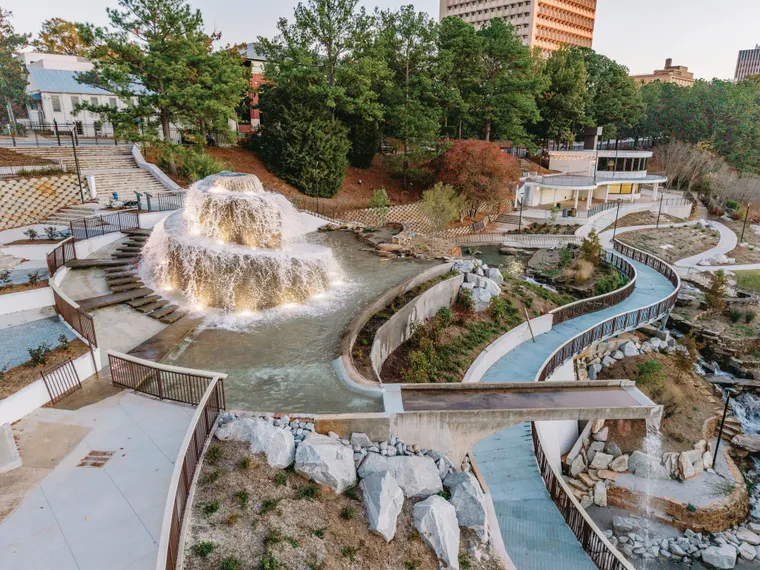
How Finlay Park’s redesign rekindled a community’s heart
By Todd Martin, Mark Johnson, and Jenny Horne
Designing urban parks typically does not start from scratch. More often, designers inherit not only complex sites and aging infrastructure, but also sites and spaces deeply rooted in city and community history.
Finlay Park in Columbia, S.C., exemplifies this—shaped by more than 170 years of physical transformation and community attachment. A 2025 renovation built on this history through a careful redesign that balanced preservation with function, history with modern use, and design legacy with contemporary urban life and park design.
Originally opened in the mid-19th century as Sidney Park, the hillside site overlooking the Congaree River was sold to the Seaboard Air Line Railroad and flattened for industrial use before being reclaimed as public space in the late 20th century. When the park reopened in 1990, landscape architect Robert Marvin—working alongside Mayor Kirk Finlay and other civic leaders—introduced a design that was notably adventurous for its time. Rather than treating the steep hillside as a backdrop, Marvin activated it, creating a sequence of walls, water features, and elevated experiences that challenged conventional park typologies and typical design practices of the time.
That ambition became both the park’s identity and its challenge. Many elements were hand-built and engineered in the field. Over time, steep slopes sagged, soil shifted, and water systems deteriorated. As a result, park programs declined, visibility into and within the park suffered, and the park’s physical complexity began to work against its everyday functionality.
When the current redesign efforts began, the question was not whether Finlay Park needed to change, but how to change the park while preserving some of its original legacy.